
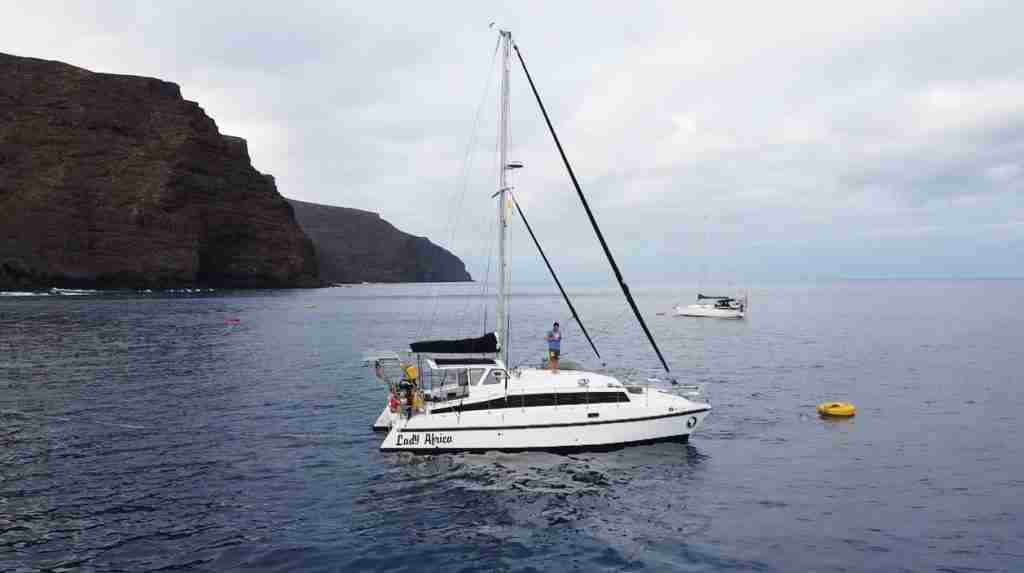
A 1991 South African catamaran taken back to bare bones and rebuilt for shoal-draft cruising — with new Vetus engines, lithium power and spares for almost everything aboard.
Some used-boat videos are a slow reveal of compromises. This one isn’t. The walkthrough of S/V Lady Africa, a 1991 Dean 365 Ocean Liner catamaran listed by terry on YachtSite.com, opens with a claim that the rest of the tour spends the next half hour backing up: the interior hasn’t been refreshed, it has been rebuilt.

“We’re not meaning that we just kind of put some instruments in and some plumbing,” the owner explains at the start. “I mean, completely rebuilt.” The galley is constructed from Nida-Core, some of the boat’s coring has been replaced with the same material, the floors are new, and the internal structures have been rebuilt. Plumbing and electrical are described as new throughout. For a 36.5-foot catamaran of this vintage, that’s the critical distinction between a project and a boat you can sail away.
A four-cabin layout that actually works
The Dean 365 is laid out with four cabins and a single head, plus an open saloon and galley. The owner calls it a “twin master” arrangement — the two forward cabins are identical mirror images of one another, each with a full double mattress, a hanging locker, around four shelves, courtesy lighting top and bottom, and dual-function reading lights that switch between red and white. Storage beneath the berths runs deep; in the video only the top three compartments are in daily use, with the rest holding spares.
The aft cabins are more compact but deliberately chosen for passages. “If we’re doing a lot of sailing, sometimes I enjoy these aft cabins — you get a good night’s rest in them,” he says, while noting the forward cabins come into their own at anchor. He lies down to demonstrate the length: at 1.7 m he has room to spare, and a two-metre guest has slept there comfortably. Each cabin is fitted with dual USB charging ports, and the aft cabins have a deck hatch and a port light for ventilation and a view out.
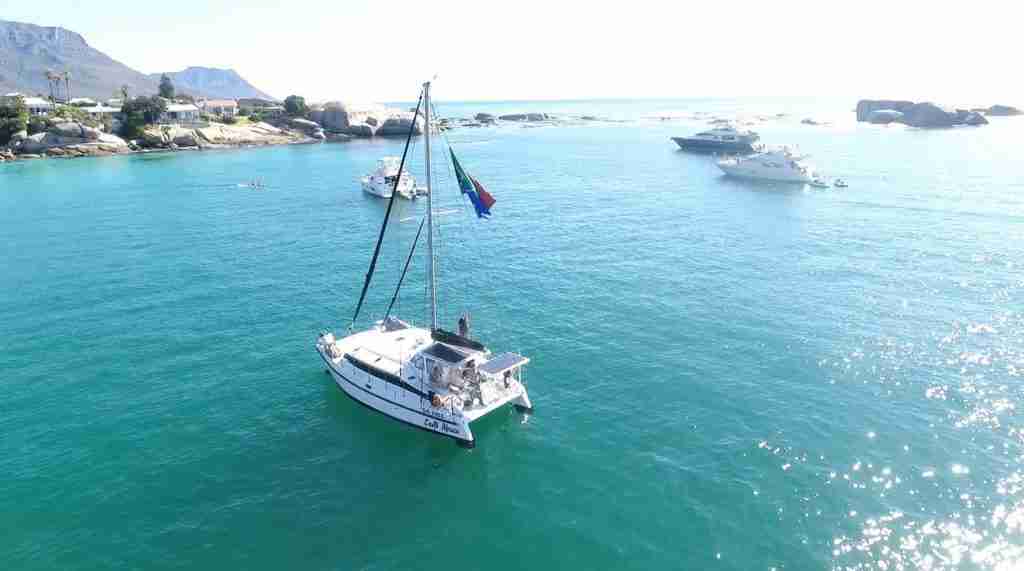
The saloon is the social heart, and the owner is unapologetic about why he likes it: seated at the table, you have a 360-degree view right around the boat. “You can be relaxing over here and you kind of got the whole view of the bay.” The table seats six at a push, four in comfort, and drops down onto a lip to convert into a daybed. Galley, fridge and freezer, washing machine and head all sit in the same zone — so whoever is cooking, washing dishes or doing laundry is still part of the conversation.
Galley and domestic systems
Storage is the recurring theme. Three shelves here, a drawer system there, more shelving behind, and — at the time of filming — a galley “fully stocked for the Bahamas,” with the provisions staying with the boat. A gas cooktop and oven dating to 2019/2020 handle the cooking. The sink has three supplies: saltwater, fresh water, and a filtered-and-remineralised drinking tap. A 110-litre fridge and a separate 120-litre freezer run on 220 volts; the freezer is insulated well enough to hold everything frozen for 12 to 24 hours without power, and a spare compressor and full rebuild spares come with it.
Two details stand out as genuinely cruiser-minded. The first is the washing machine — “probably one of the nicest things on the boat,” in the owner’s words, because it removes the chore of hunting down shore laundry in remote places. The second is the gas water heater, which he calls the best investment he made aboard: with roughly eight months of gas aboard, hot showers happen daily without running an engine. The head itself has a full-length shower with a curtain — “if you’re 2 m, you’d probably still be standing in here” — a basin, and a smart toilet with push-button eco flush.
Power, water and electronics
Lady Africa runs a dual 12-volt and 220-volt system built around custom lithium iron phosphate batteries with A-grade cells, a premium BMS and CANbus integration — meaning individual cell monitoring and full data reporting that can be viewed remotely over the boat’s internet connection. A Victron MultiPlus inverter is permanently supplying 220 volts, which is what makes the ice maker, microwave and kettle practical.
The numbers he quotes are instructive: 1,000 watts of solar across three panels, roughly 25% of battery capacity consumed overnight with fans running and little switched off, and about 70% of total capacity replaced on a typical day. He reports a week on anchor through inclement weather without needing to run a generator or engines, with the bank recovering to 100% and balancing afterwards. Two oversized DC-to-DC chargers top up from the engines under motor without straining the alternators. A Victron Color Control panel and Blue Sea breakers for both AC and DC sit behind the saloon bulkhead.
Water comes from an Oasis 30 watermaker drawing 15 amps. Each hull has its own freshwater pump, a transfer valve moves water between tanks, and tank inspection ports are accessible from inside. A saltwater pump feeds the aft deck wash and the marine heads; there’s also a fresh water deck wash that tucks away in the swim platform.
Electronics are an all-Raymarine suite — “there’s nothing on instrumentation that’s not Raymarine” — including a new 5G radar, an AIS transceiver, an independent external GPS in addition to the built-in unit, and a Raymarine 70 VHF with a full secondary radio outside rather than just a handheld extension. A Bose marine stereo system covers inside and out.
Engines, rig and deck
The engine reveal is the tour’s showpiece. Under the aft berth hatch sit new Vetus diesels with dual fuel filtration on each engine and around 500 hours on the clock — effectively just run in. New props and new sail drives go with them. The engine bays in the video are notably clean, and lit for night inspection. Diesel tanks are vinyl ester, translucent enough to inspect the fuel visually from inside the aft cabin.
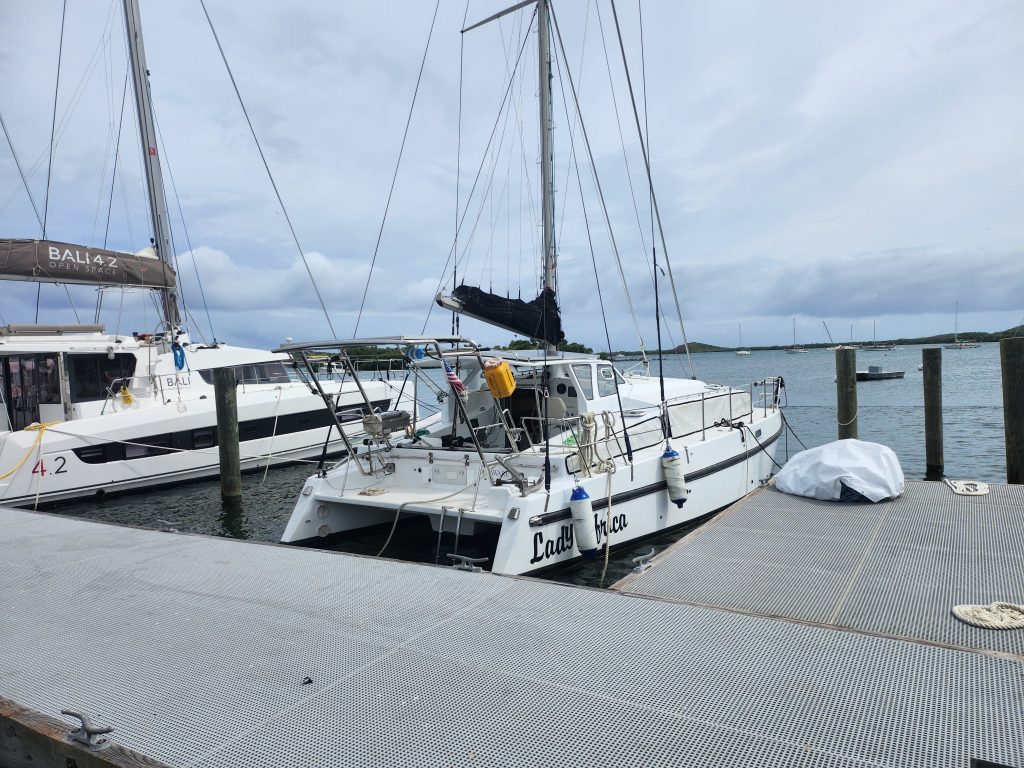
The rig is Dyneema, 10 mm and oversized for the boat, each stay covered in chafe sleeve and rated to 11 tons; the two forestays are new stainless steel cable because of the furlers. Sail handling runs through new Harken winches alongside the existing pair, a self-tacking jib track for the inner jib, and a large genoa for downwind work. A new windlass and an oversized Mantis anchor are forward. A brand-new blue asymmetric spinnaker, reinforced at the edges and never yet flown, is stowed in a forward hanging locker and comes with the boat.
Deck storage is cavernous — the forward lockers run all the way aft on both sides, perhaps two cubic metres in total. Aft, there’s a barbecue the owner rates highly, a life raft, and a 2.9 m ultralight aluminium Hypalon tender with a 15 hp Yamaha Enduro outboard. Up forward, the bow seating and flat deck have hosted 10 to 15 people at a time.
The spares inventory is unusual: spare D2 clutches, a near-complete Raymarine autopilot (less the pump), two spare BMS units, spares for the watermaker, engines and deck rigging, extra Dyneema and polyester line — plus a full set of Bosch battery power tools from router to vacuum cleaner.
Who she’s for
The owner is direct about it: “This is not a project boat. If you’re looking for a project boat that you want to do a lot of little fix-it jobs, this might not be the one for you.” EPIRBs and life jackets are in date, with PLBs fitted to the jackets and linked to the AIS. His pick of cruising ground is the Bahamas — 2.5 ft of draft, solid keels, and solid glass below the waterline means she can be beached and taken where deeper cats can’t. That said, the boat has already crossed the Atlantic, and he suggests Europe’s small marinas as an equally good fit. The sellers are moving ashore for a new adventure, and hope to pass her on to someone who’ll keep her the way they have.
Dean 365 market snapshot
Deans trade thinly — they’re a small-volume South African build — so the sample size is limited, but here’s what YachtSite’s data shows.
| Metric | Figure |
|---|---|
| Dean 365 sold, last 24 months | 1 |
| Median time to sell | ~29 days |
| Active Dean 365 listings | 1 |
| Active asking range | $151,050 |
| Inquiries, last 30 days | 4 (vs 4 prior 30) |
Given how few of these boats come to market, a condition-led example with new engines, new rigging and a documented rebuild is a different proposition from a tired one — and the spread between the figures above reflects that.